Hot Water Spa Chemistryvs.Cold Water Simming Pool Chemistry
Water care in your portable, self-contained hot tub isn’t confusing, complicated or difficult if you first understand some fundamental differences between hot water spa chemistry and cold water swimming pool chemistry.
If the advice and instructions you’ve been given don’t seem to work, it’s probably because you've been told to treat a small, covered, hot-water spa just like a big, uncovered, cold-water swimming pool.
"Four people in your hot tub is the same ‘bather load’ as 300 people in a backyard pool".(Rendezvous Spa Care Guide)
The small volume of hot water in your tub gets dirty 75 times faster than the much larger volume of cold water in a swimming pool
You can’t treat your covered, self-contained hot tub like a small swimming pool that happens to get hot. Big swimming pool chemistry simply doesn’t fit in the much smaller volume of water in your hot tub.
An uncovered swimming pool is essentially a manmade pond. The water surface is exposed to a daily load of contamination such as dust, insects, plant material and pollen.
Without a daily dose of sanitizer and weekly maintenance, an uncovered swimming pool can quickly turn into a swamp even if you don't swim in the water.
Contamination from the outside environment is the biggest variable in swimming pool chemistry and requires a daily dose of sanitizer and weekly maintenance to keep the pool clean.
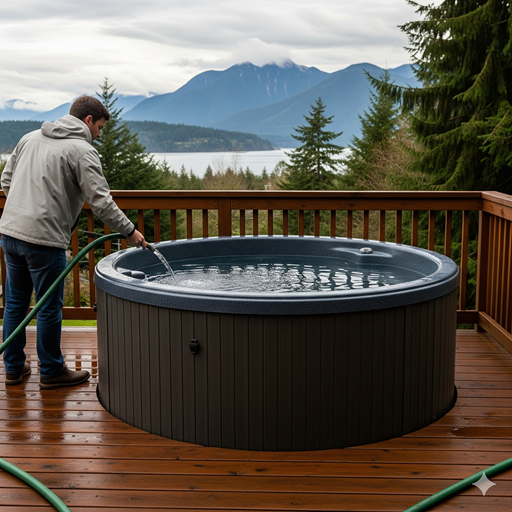
Your covered hot tub is essentially a sealed tank. The insluated cover that keeps the heat in your hot tub also keeps all the environmental contamination out.
Your covered hot tub doesn't get a daily load of environmental debris like a swimming pool so, it doesn't need a daily dose of sanitizer unless you're opening the cover and soaking in the water every day.
Contamination from bather load is the biggest variable in your covered hot tub chemistry so your covered hot tub needs very little attention between soaks.
If your hot tub is clean, clear and sanitary when you close the lid, it will pretty much stay that way for weeks or even months without any additional chemicals as long as the lid stays on.
Don't overdose your hot tub with chemicals following a daily or weekly schedule unless you are soaking in your hot tub daily or weekly.
When in doubt: Drain it out.
Here's the good news: That same small volume that makes your hot tub water get dirty 75 times faster than a swimming pool also means you can drain and refill about 75 times faster than a pool
You shouldn't spend a lot of effort, money or time trying to 'save' a small batch of hot tub water like you might for a much larger swimming pool.
Draining your tub and starting over with a fresh batch of water is usually cheaper, faster and more efficient than spending $80.00 to $100.00 on water care products and then spending several days and dozens of test strips trying to ‘fix’ your hot tub water by pouring even more chemicals into the water.
Simple Hot Tub Chemistry Secret # 1:Bather Load
When you soak, the hot water makes you sweat up to a pint an hour adding salt, minerals and metabolic waste to the water every time you use your hot tub.
All the personal care products you put on your body such as cosmetics, deodorant, lotion, moisturizer, sunscreen, hair products and even scented or deodorant soaps are dissolved off your body by the hot water and thoroughly mixed into aerated solution by your jets.
Contamination from personal care products is a leading cause of cloudy water in most personal hot tubs.
Contamination from oily products such as lotion, moisturizer, sunscreen, leave-in conditioner, etc. can leave a ring of residue around your water line and coat your filter cartridge(s).
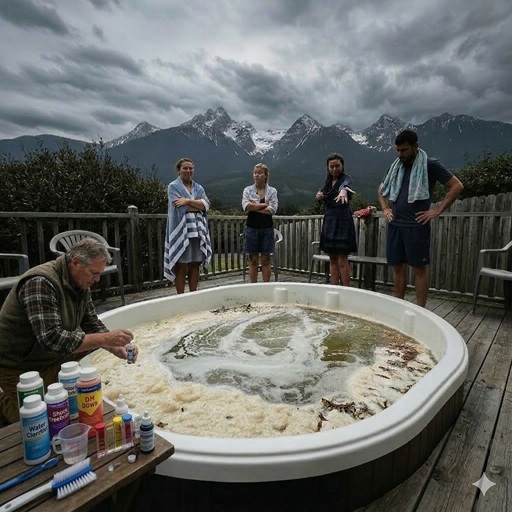
If your water is contaminated with oily products or residual soap or detergent, turning on the jets will aerate the water and cause scummy foam that floats on the surface of your water and lingers long after you turn off the jets.
IMAGE DIRTY HOT TUB
The friction from your hydromassage jets can even scrub off your body oil and dead skin. All this stuff ends up in your water as ‘bather waste’ and creates a ‘bather load’ that can suddenly and dramatically change all your hot tub chemistry.
You can reduce your bather load and avoid cloudy, foamy water by taking a shower BEFORE using your hot tub to remove personal care products so they don’t end up in your hot tub water. If you keep these products out of your hot tub water in the first place, you won’t have to add chemicals to fix it.
Bather load is the biggest variable in hot tub chemistry
The inorganic contamination from your personal care products can make the water cloudy and foamy, can alter the pH of your water and, most importantly, can quickly deplete your Chlorine or Bromine sanitizer levels.
If your sanitizer is being used up by personal care products, you’ll do a lot more work keeping your water clean, clear and sanitary.
Normally, sanitizer in your hot tub should be maintained so bacteria on your body is neutralized almost instantly as you slip into the water. High bather load can deplete Bromine or Chlorine in 30 minutes or less.
If your Chlorine or Bromine sanitizer levels are depleted by personal care products, bacteria on your body can survive and multiply exponentially.
When Chlorine or Bromine is depleted, the organic contamination from your sweat, body oil and dead skin can feed bacteria and the dark, warm, wet environment of your hot tub turns into a giant petri dish with perfect conditions for explosive bacterial growth.
High bather load: More work
'Four people soaking in a 104°F hot tub generate the same bather waste as 300 people in a 80°F residential swimming pool' (Rendezvous Spa Care Guide).
The small volume of water in your hot tub gets old, dirty and slimy a lot faster than a swimming pool and requires more frequent testing and adjustments and much more frequent drain & refill.
High bather load quickly corrupts your hot tub water making it old, dirty, slimy & slippery up to 75 times faster than a swimming pool.
If you use your hot tub every day or several times a week, the nearly universal advice from the hot tub industry is to drain and refill your tub every three or four months or as needed.
If your hot tub has a higher bather load, you’ll do more work and add more chemicals to keep it clean, clear and sanitary and you’ll have to drain and refill your tub more often.
Low bather load: Less work
If you don’t use your hot tub daily or weekly, it doesn’t really need daily or weekly attention. If you have a good cover, your hot tub becomes a sealed storage tank when you close the lid.
If your hot tub water is balanced, clean and sanitary when you close the cover, it will need very little attention until the next time you take a soak.
Your covered hot tub doesn’t really need daily or weekly attention unless it’s getting a daily or weekly dose of bather waste.
Your balanced, clean and sanitary hot tub can stay that way for weeks or even months with minimal testing and adjusting as long as the cover stays on and nobody gets in the water.
If you reduce your hot tub water temperature to 80°F or lower and set your heater to an energy-saving mode, your unused hot tub is a lot like a swimming pool in winter storage mode but with a much better cover.
Simple Hot Tub Chemistry Secret #2:Refill Cost
Would you believe the entire batch of water in your hot tub costs less than a single pint or a single pound of any product you can buy to ‘fix’ the water?
If your water comes from a well, refilling your hot tub is essentially free.
Even if your water comes from a municipal source anywhere on the Olympic Peninsula, you can probably refill a 500 gallon hot tub for less than $5.00.
You can spend $80.00 to $100.00 on various products and spend a week or two of almost daily effort trying to fix your $5.00 batch of dirty, foamy, oily, old hot tub water by adding even more chemicals or you can spend $5.00 or less and maybe an hour watching your hhot tub fill with a clean, clear fresh batch of water.
Don’t waste money or time trying to fix a $5.00 batch ofcloudy, dirty, foamy, oily, stinky hot tub water.
You can fix all the problems at the same time by draining out your dirty, foamy, oily, old water then spending maybe an hour or two of your time cleaning and refilling your tub.
Starting over with a clean, fresh batch of water is always cheaper and more efficient than spending your time and money trying to fix your dirty, old hot tub water.
(BONUS SECRET)
When you take your first soak in a clean, clear, fresh batch of water, take a moment to appreciate the difference between controlling problems by adding even more chemicals and fixing problems by dumping the whole mess down the drain and just starting over.
Simple Hot Tub Chemistry Secret #3:Total Dissolved Solids
Swimming pool chemistry... TDS... Chemical overdose... Use less or Wall of Chemistry Chlorine alternatives
Every ounce of every product you add to your hot tub water stays in that batch of water until you drain and refill. These chemical byproducts can be measured as Total Dissolved Solids (TDS) and can accumulate quickly in the small volume of water in your hot tub.
When you’re holding an empty 2lb container of any water care product, that probably means there are 2lbs of that stuff in this batch of hot tub water.
Over time, everything you add to the water leaves behind chemical byproducts that eventually build up as Total Dissolved Solids (TDS).
If you refill your hot tub with a fresh batch of water and use your hot tub every day, you can add up to 6lbs of dissolved solids over 3 or 4 months just balancing pH & Alkalinity and keeping the water clean, clear and sanitary..
When TDS gets too high, your hot tub chemistry can become very difficult to manage. As your water becomes saturated with other stuff, calcium can solidify as a rough, white scale on your shell and throughout your hot tub plumbing.
If you use your hot tub several times a week, most manufacturers recommend draining & refilling every three or four months to avoid buildup of chemical byproducts and dissolved solids.
*Add info, links to dosage tables
*A dose of chlorine in a 400 gallon tub is x Tablespoons so if you're tossing in one or two capfuls that's XX times too much.
What makes sense for an uncovered, concrete and plaster swimming pool with 35,000 to 55,000 gallons of water doesn’t make sense for a covered, plastic hot tub with 250 to 500 gallons or even a swim spa with 1,200 to 1,800 gallons.
The small volume of hot water in your tub gets dirty and saturated with dissolved solids 75 times faster than the large volume of colder water in a swimming pool.
That means you must drain & refill your hot tub much more often than a pool. Treat your hot tub more like your bath tub and less like a swimming pool.
.png "Bather Load: 4 people in a hot tub equals 300 people in a pool")